Removal, trimming, pecan work, and stump grinding for Moultrie and the working land of Colquitt County.
Call (555) 555-5555Or call — we answer. No obligation, honest advice.
Moultrie is a town where the trees earn their keep. Colquitt County is vegetable and row-crop country — the ground that hosts the Sunbelt Ag Expo every fall — and its trees are working infrastructure as much as landscape: pecans in yards and old orchard rows, shade oaks anchoring farmsteads, planted pine on the acreage, and windbreaks that have been slowing south Georgia gusts since somebody's grandfather set them out.
Dependable Moultrie Tree Service works that whole inventory. Removals when a tree's time comes, trimming that keeps limbs off rooflines and machine paths, pecan care that respects what those trees are, storm cleanup when the Gulf sends trouble north, and stump grinding to finish the job right.
Free written estimates for town yards and farm properties alike. Call (555) 555-5555.
Hurricane Michael crossed southwest Georgia as the strongest storm this region had ever recorded, and Colquitt County took it directly: hundreds of trees down countywide, fifty thousand customers dark, roads impassable for days. The pecan belt to our west lost entire orchards that had stood for generations.
Every tree conversation in this county happens downstream of that day. Which trees stood, which failed, and why — Michael answered those questions at full scale, and the answers still guide good tree work here.
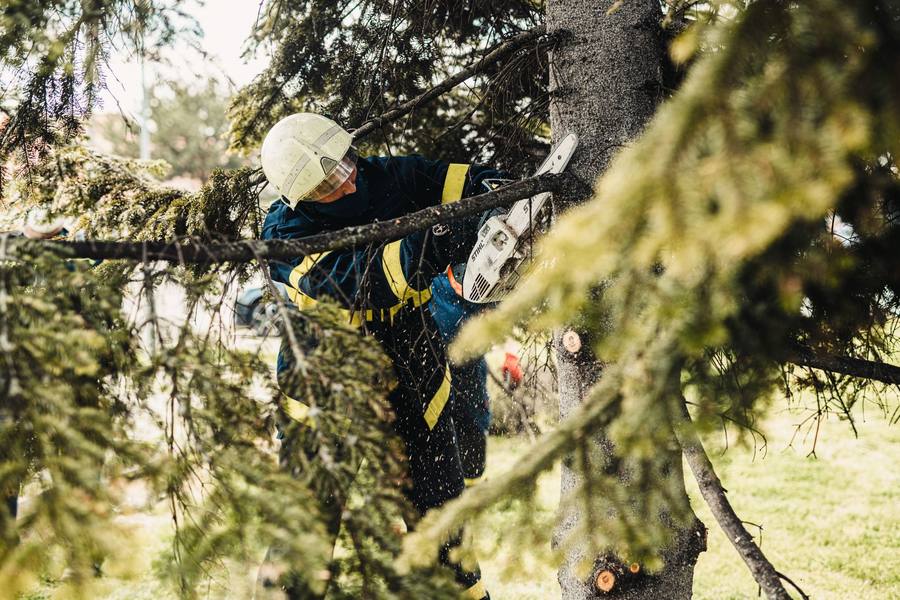
Three services cover the yard, the farmstead, and the field edge. Each has its own page with details.
Dead, storm-broken, and declining trees taken down in sections — from a backyard water oak to a windbreak pine leaning over the equipment path.
Clearance over roofs, drives, and barn lots, deadwood removal, and pruning informed by how nut trees actually grow and fail.
Stumps ground below grade — including old pecan rows pulled decades ago — so ground goes back into use.
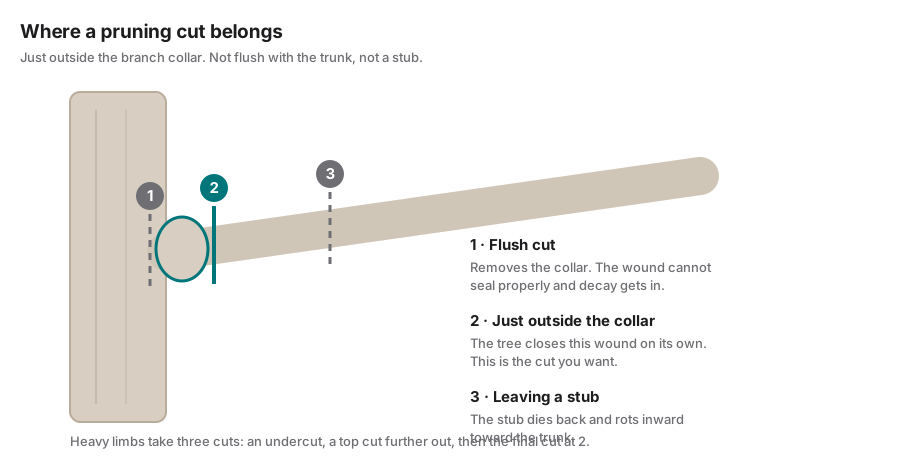
Trees seal wounds at the branch collar — the raised ring where limb joins trunk. Cut just outside it and the tree closes the wound; cut flush or leave a stub and you've created a permanent entry point for decay in a climate that gives fungus a nine-month season.
Pecan country understands this instinctively, because commercial growers live by cut quality — a bad cut on a bearing tree is money lost for years. Your yard trees deserve the same standard the orchards demand.
The one practice worth refusing from anyone: topping. A topped tree answers with fast, weakly-attached shoots that turn the next storm into a bigger problem than the one you paid to solve.
After Michael, and again after Helene battered the pecan belt east of us in 2024, Georgia's researchers surveyed thousands of downed orchard trees looking for the pattern. What they found is useful far beyond orchards: wind vulnerability peaks in mid-size trees — trunks around a foot to fourteen inches through — while the very young flex through storms and the well-anchored old-timers with sound wood often ride them out. Damage tracked wind speed, crown size, and prior defects far more than raw age.
The translation for a Colquitt County yard: your medium-size, fast-growing trees in the open are your highest storm risk, not necessarily the big old oak. And crown management — reducing over-extended limbs, thinning where genuinely needed, keeping deadwood out — measurably changes how a tree loads in wind.
Yard pecans carry a second economy nobody should ignore: those nuts are worth real money in a good year, and a pecan managed for both shade and crop is one of the few trees that pays its own maintenance. Pruning one on shade-tree logic wastes that; pruning it with orchard sense keeps the checks coming.
The honest caveat that comes with all of it: no amount of pruning storm-proofs a tree against another Michael. What good work does is remove the predictable failures — the deadwood, the split unions, the leaners — so the storm has less to work with.
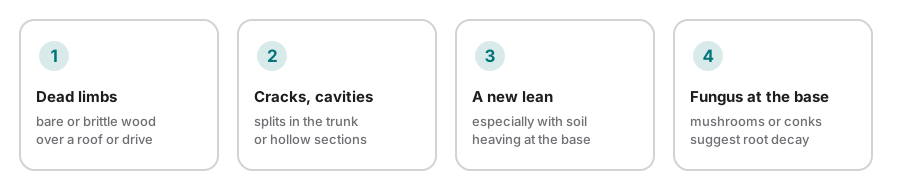
Dead limbs, cracks or cavities, a new lean, and mushrooms at the root flare — in a county that remembers Michael, any of the four justifies an evaluation before the next season.
The same process for a town yard on 2nd Street SE and a fence line out toward Doerun.
Someone looks at the actual trees, on the actual ground, and writes the price down with cleanup included.
Around planting, spraying, and harvest windows — tree work on ag land happens when the calendar allows, and the schedule respects that.
Wood hauled or stacked, brush chipped, ruts avoided in soft ground. On working land, leaving the ground right is half the job.
Ag-country tree work has its own job list that town crews rarely see. Volunteer trees swallowing a fence line until the fence needs replacing. A field-edge oak spreading far enough to shade out two rows and snag a boom. Windbreak pines dying one by one and dropping limbs where equipment runs. A dead tree standing over the path between the barn and the road, waiting for the worst morning to fall.
That work gets done with farm logic: timed to the crop calendar, equipment routed to spare soft ground, wood dealt with on-site where that's the practical answer, and fence lines cleared in a way that doesn't cost you the fence.
For town properties the list is more familiar — roof clearance, driveway shade, the water oak that's been dropping limbs since the last wet summer — but the standard is the same: written scope, clean cuts, finished ground.
Windbreaks earn a special word because Michael proved their value the hard way: rows that had been maintained — gaps replanted, dead stems removed — kept doing their job through the recovery years, while neglected rows became a line of individual hazards. A windbreak is a system, and it gets serviced like one: walk the row, mark the dead and the dying, take them out before the wind chooses the order, and plan replacements so the gap never gets wide enough to matter.
Based in Moultrie and covering Colquitt County — town neighborhoods, the farmsteads and field edges along the county roads, and the communities from Doerun to Berlin to Norman Park.
On the county line or just past it? Call anyway — the answer is usually yes.
Seat of Colquitt County, home of the Sunbelt Ag Expo, in the heart of south Georgia's working farmland.
When the next system comes through, three rules keep Colquitt County homeowners out of trouble. First, the tensioned wood: trunks pinned under other trees and limbs hung in canopies store violent energy, and the chainsaw injuries that follow every storm come from cleanup, not wind. Anything under load, and anything near a line, is professional work.
Second, the paperwork: photograph damage before touching it, for insurance. Third, the strangers: storms pull out-of-area crews down every highway in Georgia, quoting cash prices that exist only today. Georgia doesn't license tree work at the state level, so your verification is the entire safety net — insurance certificate sent straight from the insurer, local references, scope in writing. Anyone who resists any of that has answered your question.
Michael taught this county what recovery looks like when it's organized and what it costs when it isn't. The organized version starts with who you let on the property.
A pecan that needs real pruning, a dead pine over the equipment path, a stump row from trees Michael took, or a yard oak dropping limbs on the roof — call (555) 555-5555 and describe it. Free written estimate, a real arrival window, and ground left the way working land should be left.
Trees announce their failures in advance. The estimate is how you get the announcement in writing.
Tell us what you need and we'll get back to you with a real answer. If it's an active backup or standing water over the field, calling gets you a faster response.
Call: (555) 555-5555
Area: Moultrie, GA and Colquitt County